Co-Ord Set Indian Style: What It Is and How to Wear One
A co-ord set is a matching top and bottom made to be worn as one outfit. The Indian version swaps in tunics, palazzos and block prints, and each piece still works alone.
In short
- A co-ord set is a top and bottom cut from the same or matching fabric and designed to be worn together, and the Indian version usually pairs a tunic or kurta-style top with palazzos or straight trousers.
- A hand block print is stamped by hand with carved wooden blocks, so small breaks in the repeat are a sign of the craft and not a fault.
- To wear the pieces apart, keep the other half plain: a printed tunic over jeans, or wide printed trousers with a white T-shirt.
- Cotton and linen suit heat, viscose and silk blends suit mild days, and wool blends, knits and velvet suit real cold.
- Across the size charts of about 8,000 women's sets, a size M typically had a 38 in (97 cm) bust and a 26 in (66 cm) inside leg, so compare those figures with your own before you choose.
A co-ord set is a matching top and bottom made to be worn as one outfit. Co-ord is short for coordinated. In its Indian form, the top is usually a tunic, short kurta or shirt with palazzos or straight trousers, often in block prints, cotton or linen, and each piece still works on its own.
That last part is why it earns wardrobe space. You get one easy outfit for a Saturday brunch in Sydney, plus two separates for the jeans and plain tees you already own. Here is how to tell the styles apart, how to wear them at work and on a trip, what to put on your feet, and which fabric suits your weather. Browse co-ords as you read.
How is a co-ord different from a kurta set or a suit?
A co-ord is the most casual of the three and the easiest to split up. The lines do blur: a kurta with matching trousers and no dupatta can be sold under either name. If you want the fuller picture on that side, read what a kurta set is.
| Compare | Co-ord set | Kurta set | Pantsuit |
|---|---|---|---|
| Top | Shirt, tunic, crop top, T-shirt or jacket | Kurta, usually knee length or lower | Tailored blazer |
| Bottom | Palazzos, trousers, skirt or shorts | Palazzos, straight pants, churidar or sharara | Tailored trousers |
| Dupatta | Rarely, and optional | Common in three-piece sets | Never |
| Mood | Relaxed and current | Traditional to festive | Formal |
| Works in pieces? | Yes, it is built for it | Sometimes, mostly the bottom | Yes, the blazer especially |
What does Indian style mean in a co-ord?
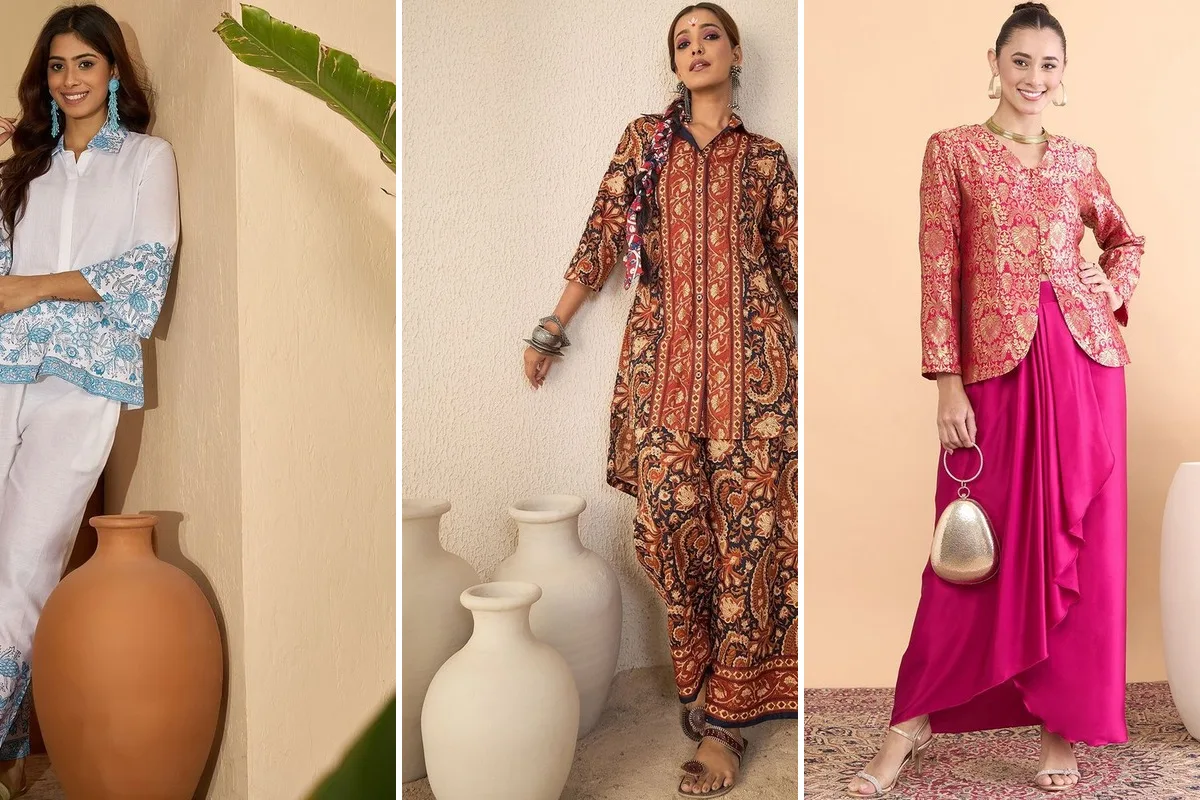
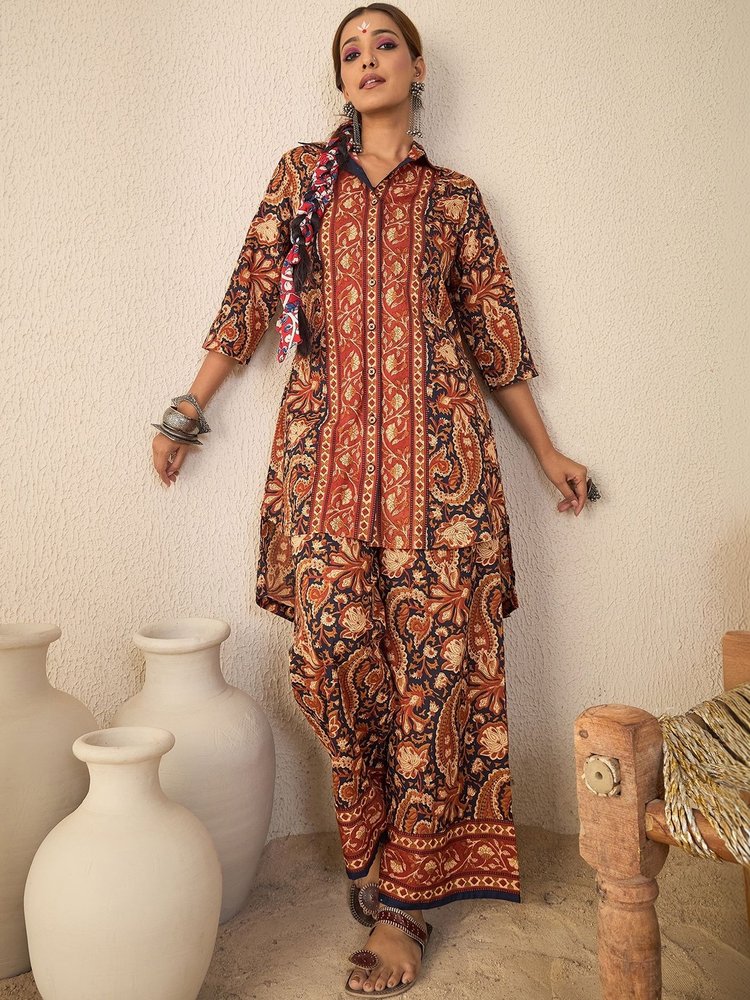
It means the cut and the surface come from Indian dress, while the idea of a matching two-piece stays global. Look for side slits and curved hems on the top, notched or mandarin necks, roomy palazzos, and prints such as paisley, floral jaal (an all-over trellis pattern) and printed ikat, which copies the soft blurred edge of the woven kind. A loud print on both pieces is the signature look, and it is confident enough that you can skip most jewellery.
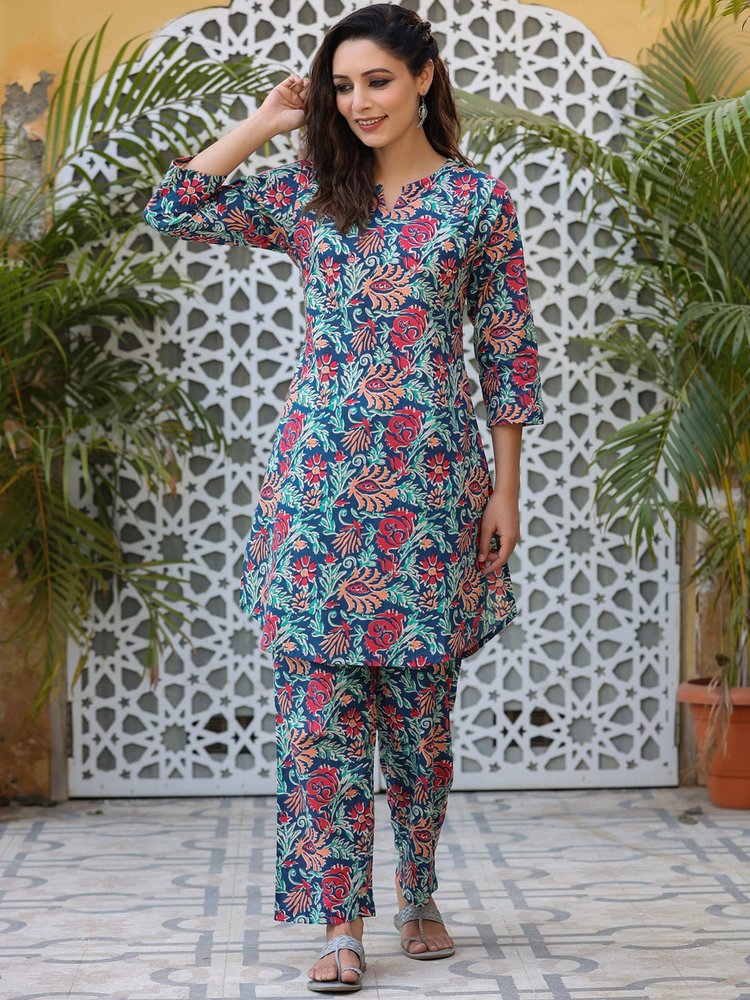
Printed sets with an Indian hand
Paisley, florals and geometric borders on tunics, a peplum and palazzos.


What is a block print co-ord, and how can you spot a real one?
A block print co-ord is printed by hand: a craftsperson dips a carved wooden block in dye and presses it onto the cloth, repeat after repeat. Sanganer and Bagru, near Jaipur in Rajasthan, are the best known centres. Sanganer is known for fine florals on a pale ground. Bagru leans earthier and is tied to dabu, a mud-resist method where a paste of black clay, lime, wheat chaff and gum keeps the dye out of the pattern, usually before an indigo bath. Ajrakh, from Gujarat, is a separate and very layered tradition.
- Look at where the repeats meet. Hand printing leaves tiny gaps and overlaps. Perfectly seamless patterns usually mean a machine.
- Look at the colour. Slight changes in depth from motif to motif are normal in hand work.
- Read the words. Hand block printed is a claim about method. Printed on its own says nothing, and digital print means an inkjet process, which gives crisp lines and smooth colour fades.
- Know kalamkari too. The name means pen work, and the designs are hand drawn or block printed, often with flowers and vines in muted plant-like tones.
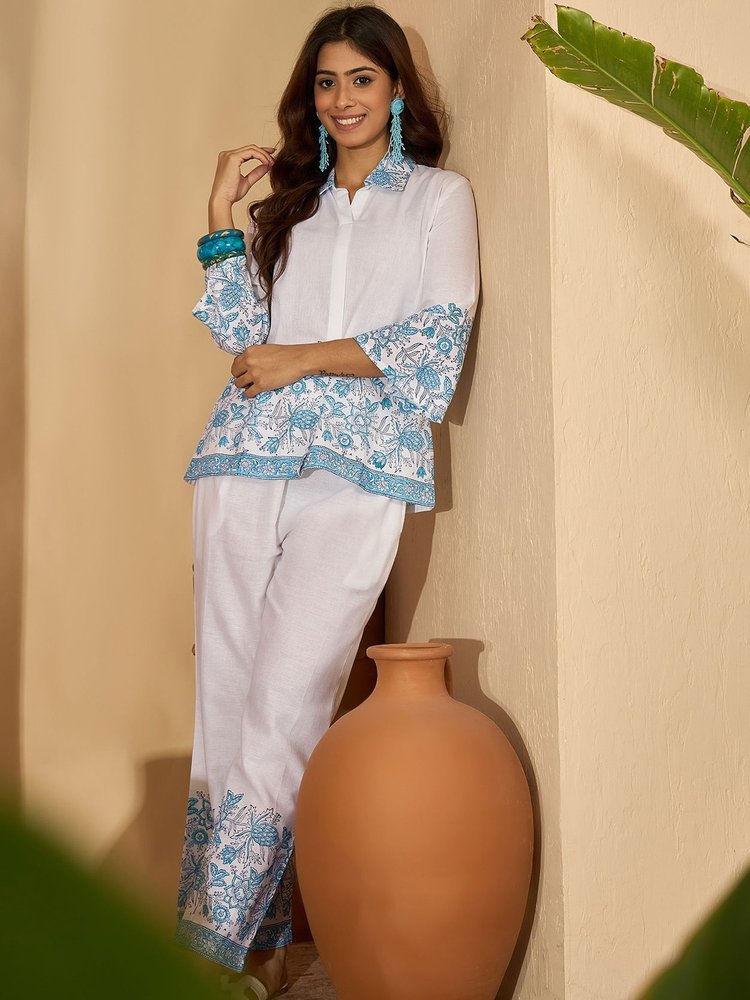
Hand block print and kalamkari sets
Pure cotton, from white and indigo to a patchwork in purple.


How do you style a co-ord set when you wear it together?
Treat it as a single statement and keep everything around it quiet. One print from neck to ankle is already a lot of information, so you rarely need a second pattern anywhere.
- Break the line if you feel swamped. Half tuck a shirt, add a thin belt, or layer an open jacket in a plain colour.
- Mind the hem. Wide trousers should skim the top of your shoe. A cropped slim leg should clearly show the ankle.
- Pick up one colour. Match your earrings or shoes to a shade in the print and the whole thing looks planned.
- Leave a little skin or space at the neck. A high neck, a full print and big earrings together can feel heavy on a shorter frame.
How do you wear co-ord pieces separately?
Keep the other half plain so the piece you borrowed still looks intentional. Very bold head-to-toe prints lose some punch when split, so start with the quieter half. Solid sets in white, black or beige are the easiest of all to take apart.
| Piece | Wear it with | Good for |
|---|---|---|
| Printed tunic | Straight blue or white jeans, flat sandals | Coffee, school runs, weekends |
| Button-up shirt top | Worn open over a plain slip dress, or tucked into a solid skirt | Dinner, warm evenings |
| Palazzos | White T-shirt or black bodysuit, tucked in | Lunch, casual office days |
| Blazer | Jeans and a plain tee, or over a kurta | Work, meetings, flights |
| Crop top | A high-waisted skirt, or as a contrast blouse under a saree if the fit allows | Parties, festive evenings |
| Shorts | A loose linen shirt or a light knit | Holidays, hot days |
Can you wear a co-ord set to work?
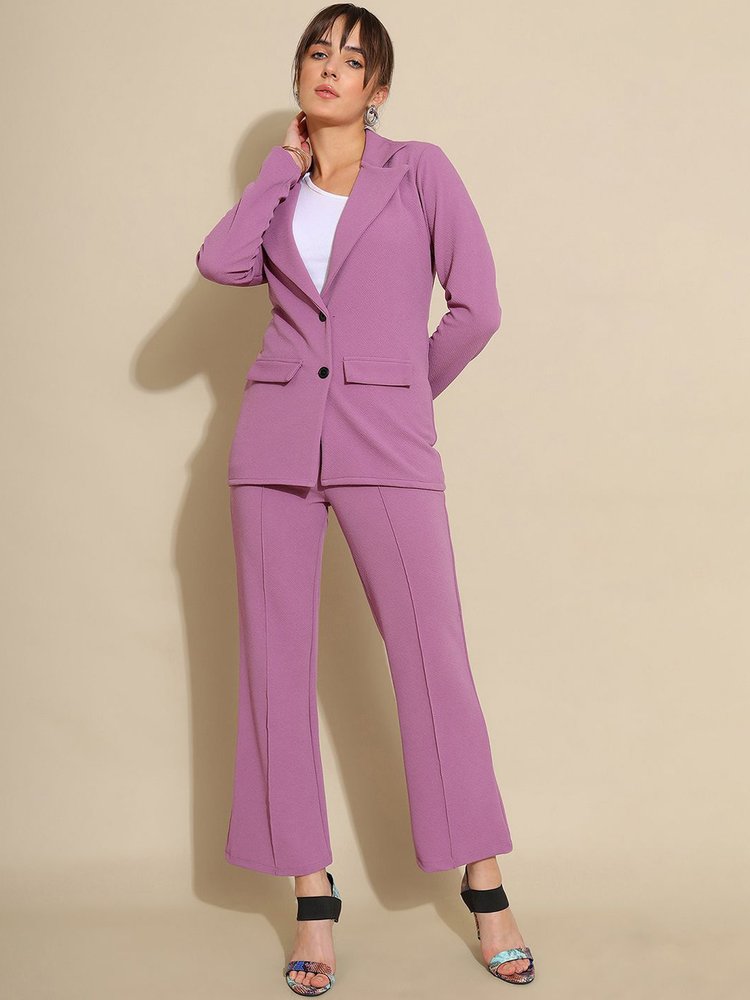
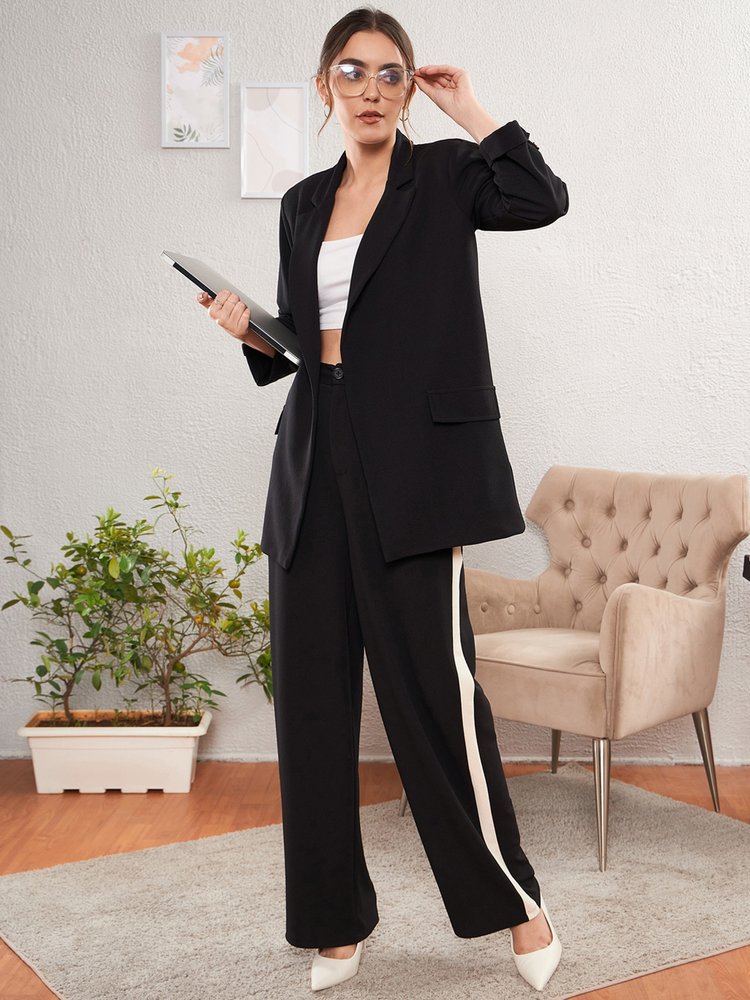
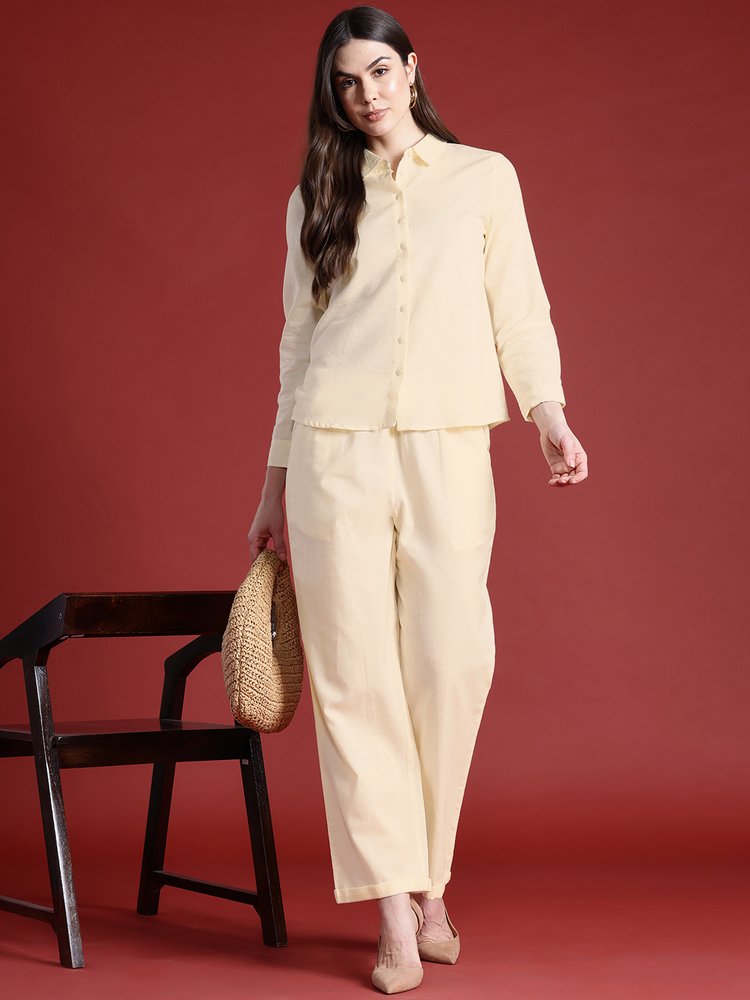
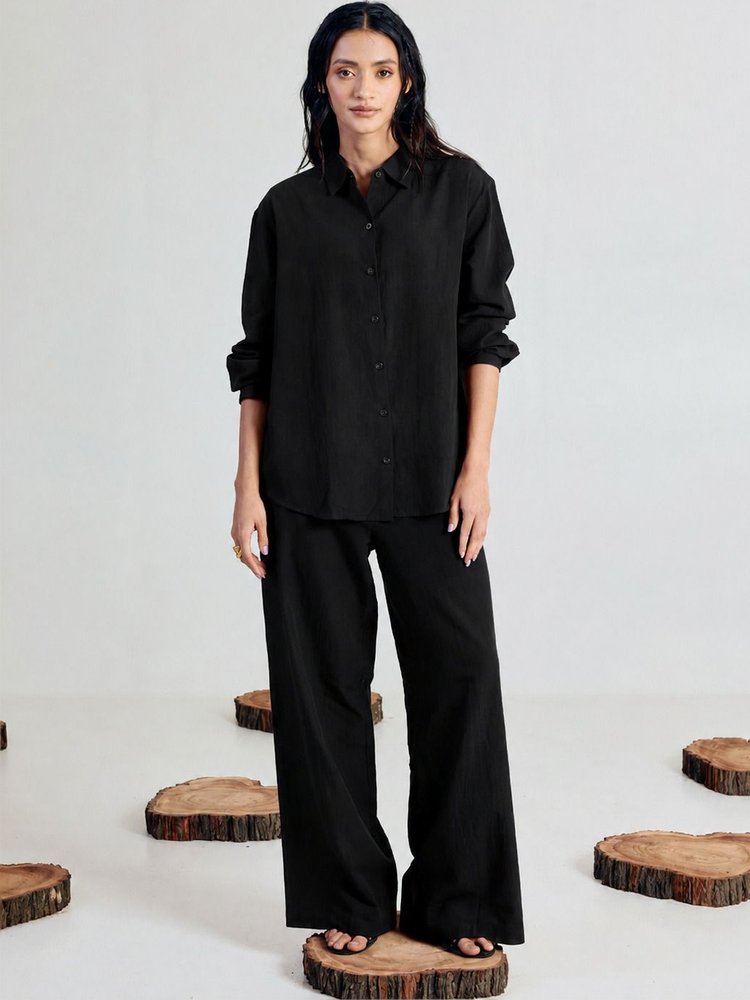
Yes, and solid colours are the safe route. A blazer set reads as a softer suit, and a linen shirt with matching trousers looks tidy without the stiffness. Keep prints small if your office is formal. For a client-facing day, choose a set with a proper collar and a closed shoe, then add a plain structured bag.
Sets that behave at the office
Two blazer sets and two relaxed shirt-and-trouser sets in linen blends.
What co-ord should you wear to brunch?
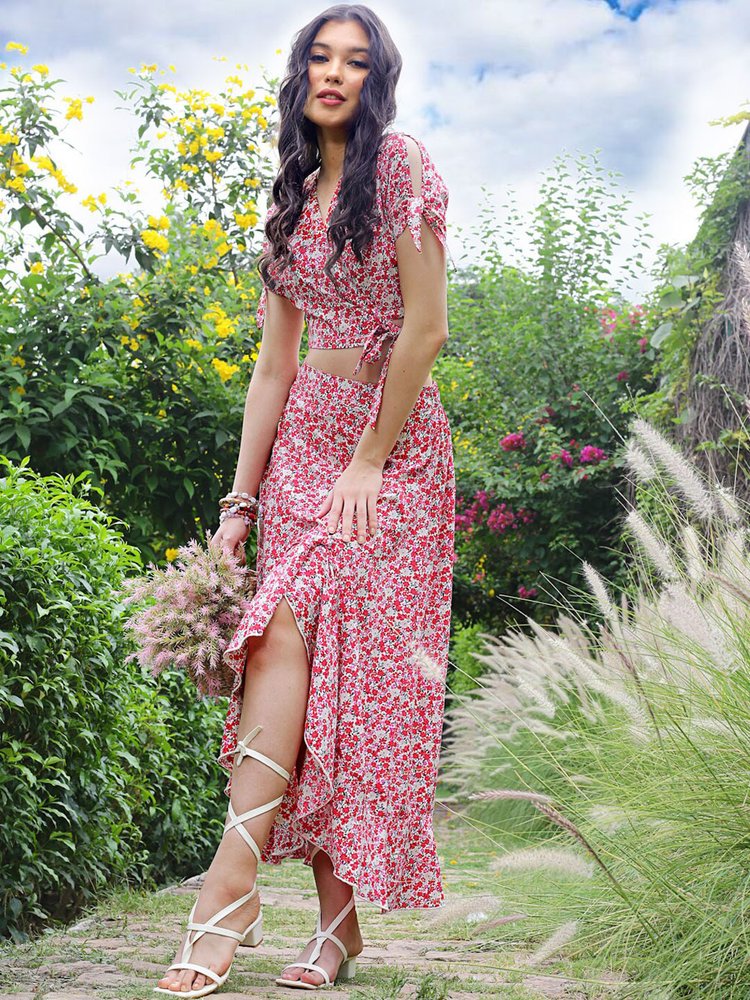
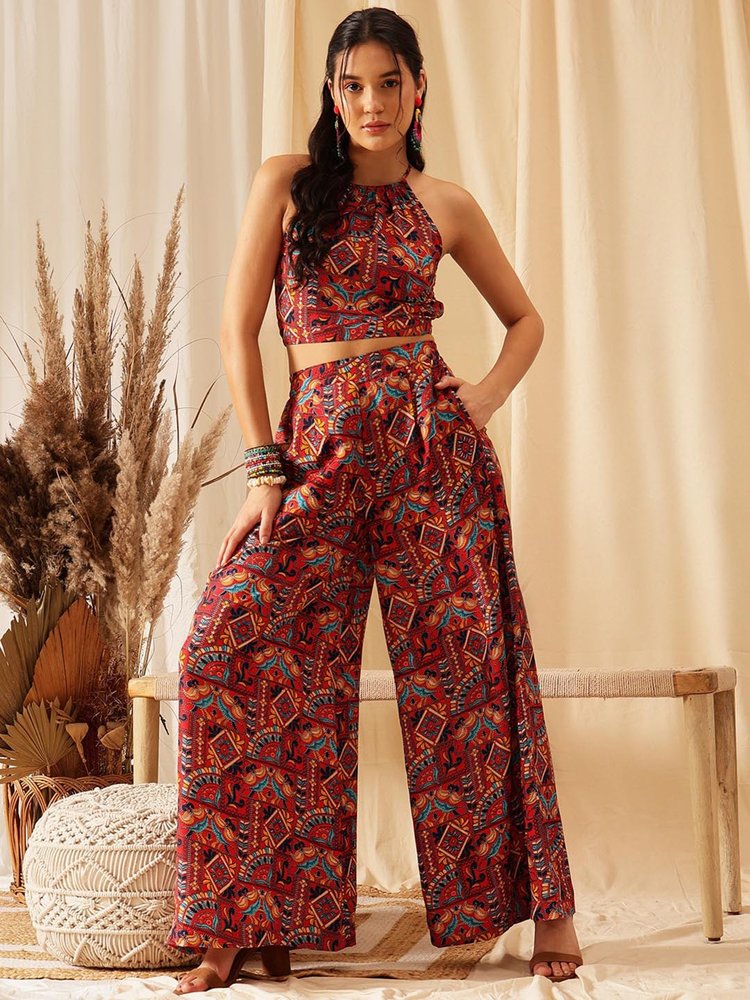
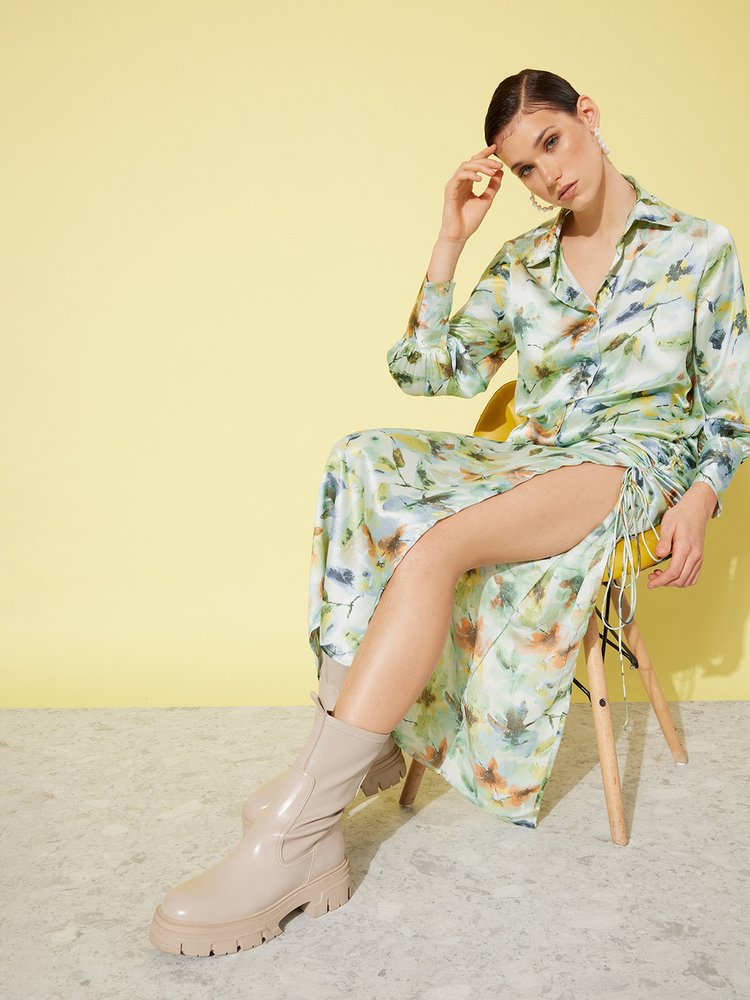
Go for movement and colour: a wrap top with a flowing skirt, a printed strappy top with wide palazzos, or a floral shirt with a midi skirt. These are the days to enjoy a print. Flat sandals keep it easy, and a pair of chunky ankle boots toughens up anything floral once the weather cools.
Weekend sets with some swing
A wrap top with skirt, a red printed palazzo set and a satin shirt with midi skirt.
Is a co-ord set good for travel?
Yes, because two sets give you at least four outfits, and more if they share a colour. Soft trousers with elastic or drawstring waists also sit well through a long flight. Viscose, polyester and knits crease less than linen, so roll those for the suitcase and keep linen for the days you do not mind a lived-in look. Pockets are worth checking for, since a phone and passport need somewhere to go.
Easy sets for the plane and after
A plain T-shirt set with pockets, and a floral silk-blend shirt set with a drawstring waist.


Can a co-ord work for a party, Diwali or a wedding event?
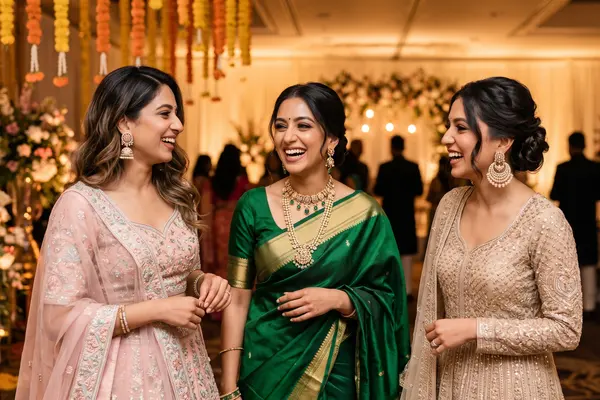
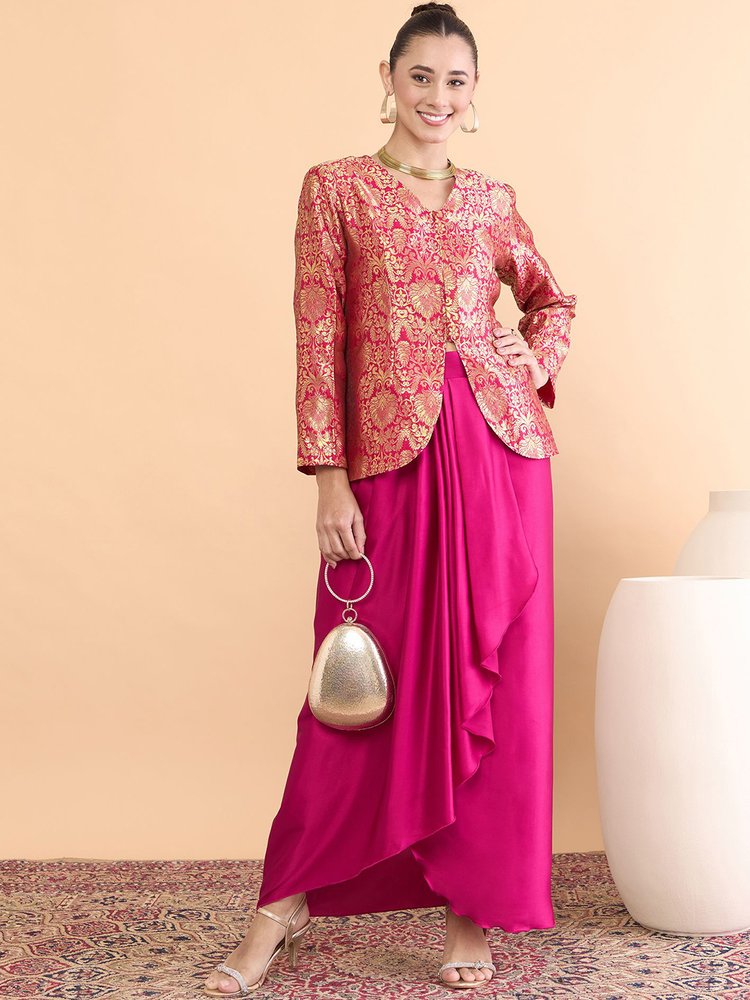
Yes, if the fabric carries the occasion. Brocade, velvet, embroidery and a jacket layer lift a set to party level, while a printed cotton one stays daytime. It suits Diwali parties, a sangeet (the music and dance night before a wedding) or a reception in a less traditional family. For the ceremony itself, check our guide on what to wear as a wedding guest, since older relatives may expect something more formal.
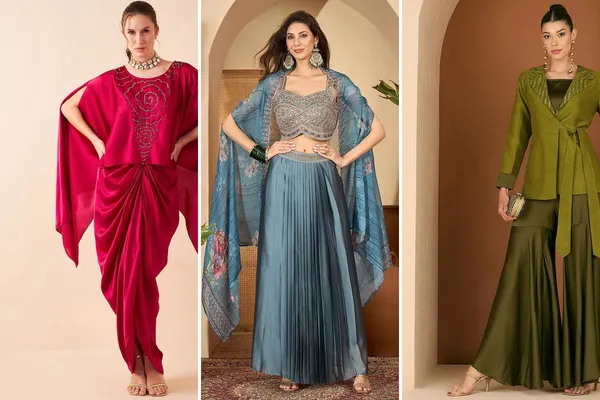
Dressed-up sets for evenings
A brocade top with draped skirt, green velvet with a matching skirt, and a three-piece with an embroidered jacket.


What shoes and jewellery go with a co-ord set?
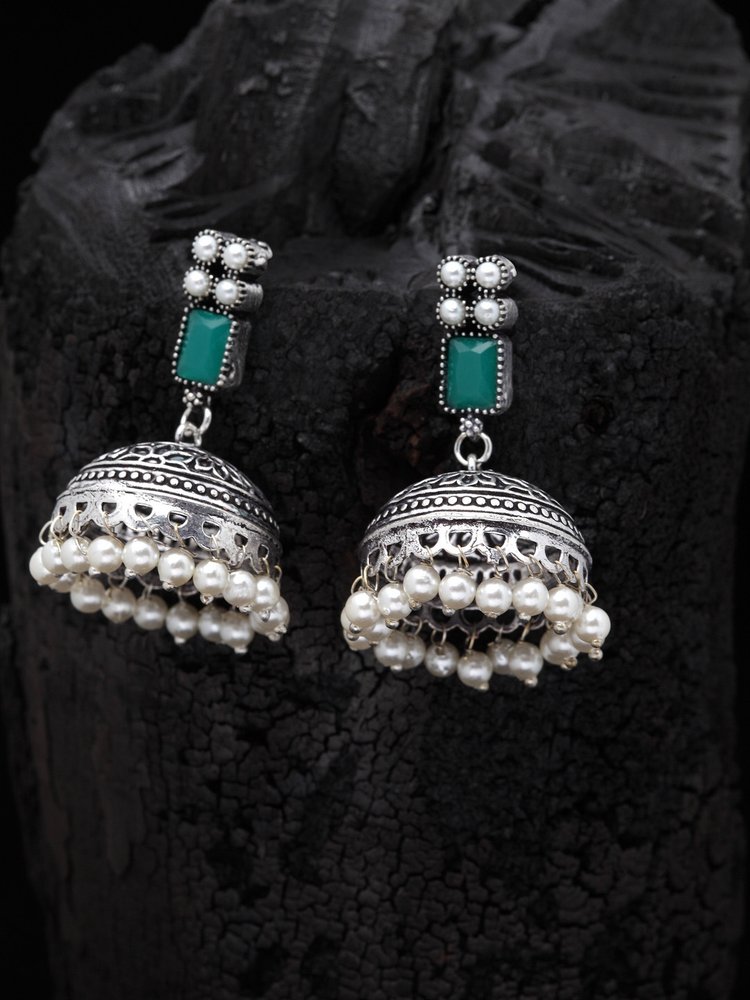
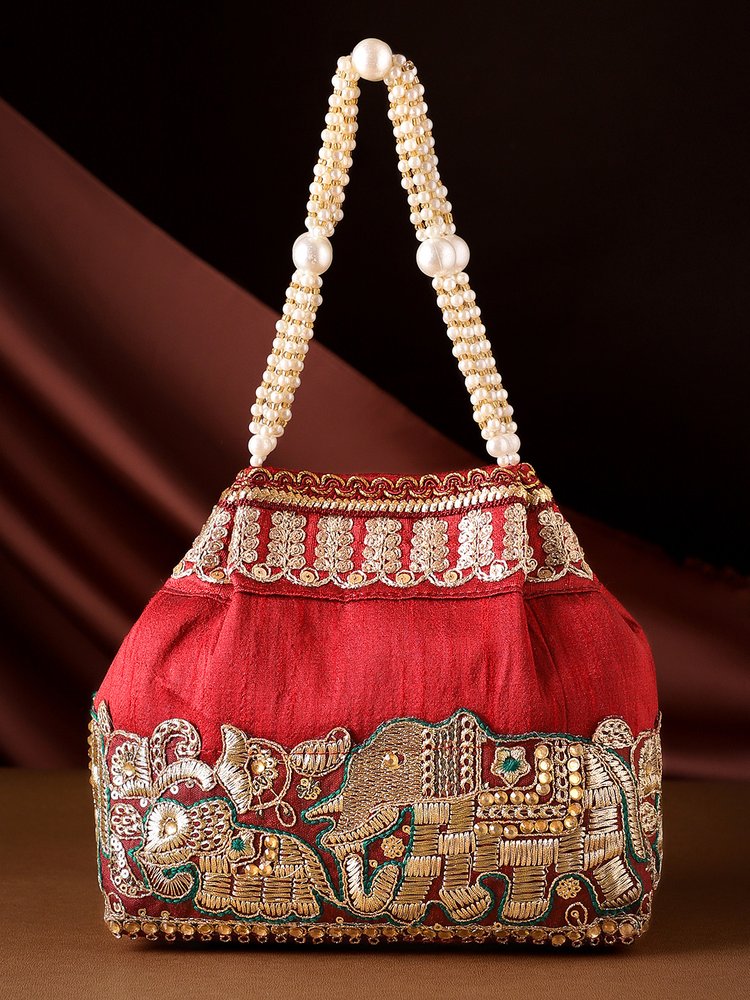
Match them to the fabric, not the colour. Cotton and block prints want handmade, earthy pieces, while tailored sets want clean lines. Two words you will meet: a jutti is a closed embroidered slip-on, and a kolhapuri is an open leather sandal with a toe loop. Browse juttis and flats, earrings and clutches and potlis, a potli being a small drawstring pouch.
| Your set | Shoes | Jewellery | Bag |
|---|---|---|---|
| Block print cotton | Kolhapuris, juttis, flat sandals | Oxidised silver jhumkas (bell-shaped earrings), bangles | Woven basket or jute tote |
| Plain linen | White sneakers, loafers, slides | Fine chain, small hoops | Canvas or leather tote |
| Blazer set | Pointed pumps, block heels | Studs and a watch | Structured tote |
| Satin or bold print | Strappy heels, ankle boots | One statement earring, no necklace | Small clutch |
| Brocade or velvet | Embellished juttis, metallic heels | Kundan (set glass stones) or gold-tone pieces | Potli |
The finishing pieces
Jhumkas, kolhapuris, block heels, Chelsea boots and a potli to mix across the sets above.


Which co-ord fabric suits your climate?
Choose by how much your weather asks of the cloth. Natural fibres let air through, and heavier piles and wool hold warmth. Save satin and heavy polyester for air-conditioned rooms and evenings, since they trap heat in humid weather.
| Your weather | Reach for | Where this fits | Skip |
|---|---|---|---|
| Hot and humid | Cotton, cotton lawn, linen | Dubai, Singapore, a Sydney summer | Satin, polyester, lined pieces |
| Warm and dry | Linen, cotton, light viscose | California, Perth | Velvet |
| Mild and changeable | Viscose, silk blends, a jacket layer | London in spring, Melbourne, Vancouver | Sheer pieces alone |
| Properly cold | Wool blends, cable knits, velvet | Toronto, Calgary, a northern UK winter | Thin cotton without layers |
In real cold, wear a thin thermal under the tunic, add a long coat, and swap sandals for boots. The same logic runs through our winter outfit guide for Canada.
Sets for cold days
A woven paisley wool blend tunic set, a cable knit in wool and a belted velvet set.


How should a co-ord set fit, and which size should you pick?
Most sets come in one size for both pieces, so choose by whichever part of you needs the larger size, then check the product's own size chart. We read the size charts of about 8,000 women's co-ord sets to give you a starting point. All figures are for size M and describe the garment, not the body.
| Size M measure | Typical figure | What to check |
|---|---|---|
| Bust of the top | 38 in (97 cm) | Allow room to move: compare with your own bust plus a little ease |
| Waist of the bottom | 30 in (76 cm) | Many are elasticated, so treat this as the starting point |
| Inside leg | 26 in (66 cm), most between 25 and 28 in (64 to 71 cm) | Longer legs will show ankle, which suits wide legs better than slim ones |
| Each size step | About 2 in (5 cm) at the bust | Between sizes, go up in a set without stretch |
If you are used to US, UK, EU or Australian labels, our Indian size chart for women converts them.
Keep reading
Questions people ask
What is a co-ord set in Indian fashion?
It is a matching top and bottom designed as one outfit, usually a tunic, short kurta or shirt with palazzos or straight trousers. Prints such as paisley and block print are common. It looks Indian but needs no draping or dupatta.
Is a kurta and palazzo set the same as a co-ord?
They overlap. A matching kurta and palazzo with no dupatta is often sold as a co-ord, especially if the kurta is short. A longer kurta with a dupatta usually reads as a kurta set and feels more traditional.
Can you wear a co-ord set with a dupatta?
Yes, and it is the quickest way to make one look more traditional for a festive day. Pick a dupatta or stole in a plain colour if the set is printed, or a printed one if the set is plain. Drape it over one shoulder so the outfit still looks light.
How do you style a co-ord set in winter?
Choose wool blends, knits or velvet, or layer a lighter set with a thermal, a long coat and boots. A wide-leg trouser fits comfortably over thin leggings. Keep the coat in a solid colour if the set is printed.
How do you style a white or black co-ord set?
Plain sets are a blank page, so use them to show off one thing, such as big earrings, a bright bag or printed shoes. White looks fresh with oxidised silver and tan leather. Black takes gold jewellery and metallic heels well, and works from office to dinner.
Can you wear a co-ord set to an Indian wedding?
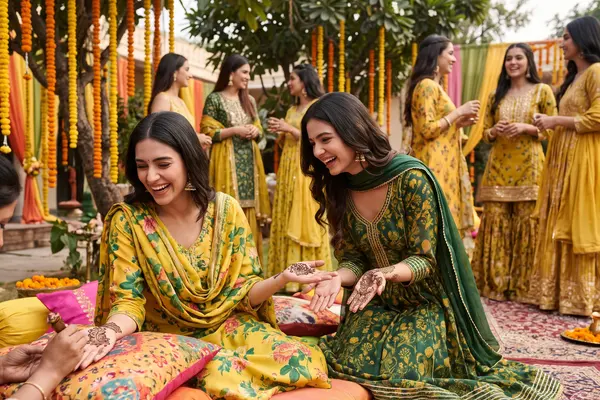
For casual events such as a mehendi (the henna party) or a relaxed sangeet, a dressy embroidered or brocade set works. For the main ceremony, a saree, lehenga or anarkali is the safer choice unless the family has said otherwise. Printed cotton sets are best kept for daytime.
Do men wear co-ords too?
Yes. Men's sets are usually a shirt or polo with matching trousers or shorts, such as this knit polo and trouser set. Wear the top alone with denim, and the trousers with a plain tee, the same way.
About the numbers
- TiaBow catalogue, women's co-ord sets, garment measurements for size M, read 2026-11-03: about 7,200 to 8,000 sets gave each figure: median bust 38 in, bottom waist 30 in and inside leg 26 in, with the middle half of inside legs between 25 and 28 in; the median step from M to L was 2 in at the bust
- Wikipedia, Dabu printing, read 2026-11-03: the paste of black clay, lime, wheat chaff and gum, the indigo dyeing, and Bagru and Sanganer among the centres
- Google autocomplete, United States, read 2026-11-03: the questions people type about styling co-ord sets, including with a dupatta, in winter and for a party