What Are Juttis? Styles, How to Wear Them, Fit and Breaking In
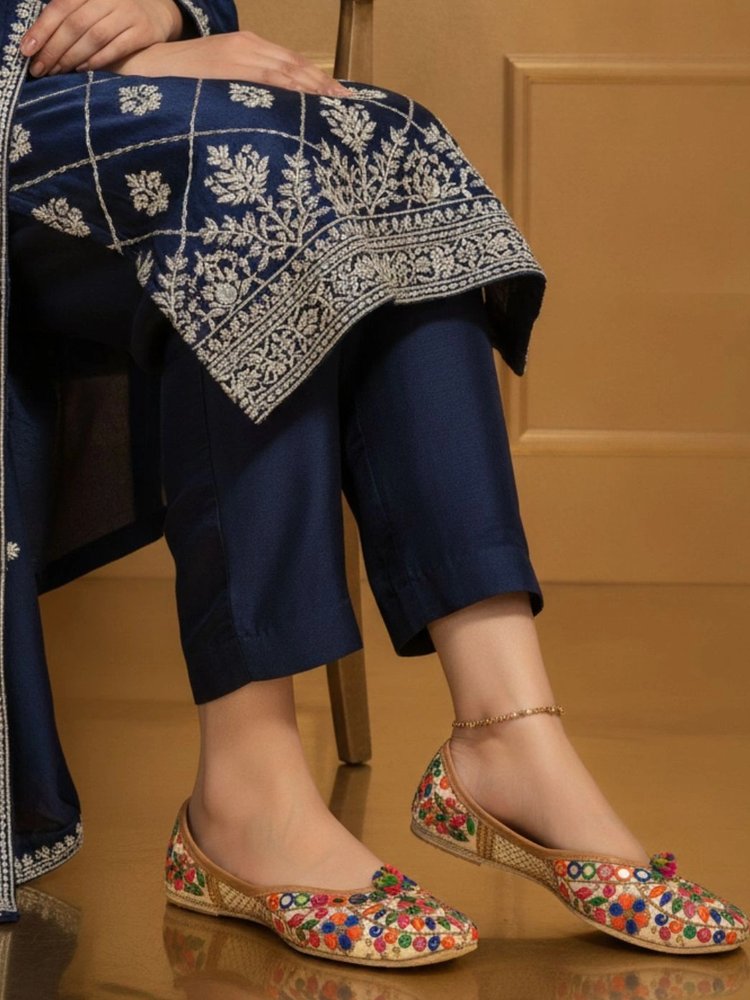
Juttis are flat, closed slip-on shoes from the Punjab region, made in leather or fabric and usually embroidered. Classic pairs have no left or right until your feet shape them.
In short
- A jutti is a flat, closed slip-on shoe from the Punjab region, made of leather or fabric and usually embroidered on the upper.
- Juttis and mojaris are close cousins: jutti points to Punjab, mojari to Rajasthan, and many labels now use both words for one shoe.
- Leather juttis feel tight at first and soften to your foot, while synthetic pairs with a cushioned footbed feel easier on day one but give less over time.
- Juttis go well beyond ethnic wear: cropped jeans, midi dresses and tailored trousers all leave the embroidery on show.
- Buy by foot length in centimetres, because Indian shoe sizes follow the UK scale rather than the US one.
- Keep juttis dry, wipe them with a soft cloth and store them in a cloth bag, since thin soles and embroidery do not enjoy rain.
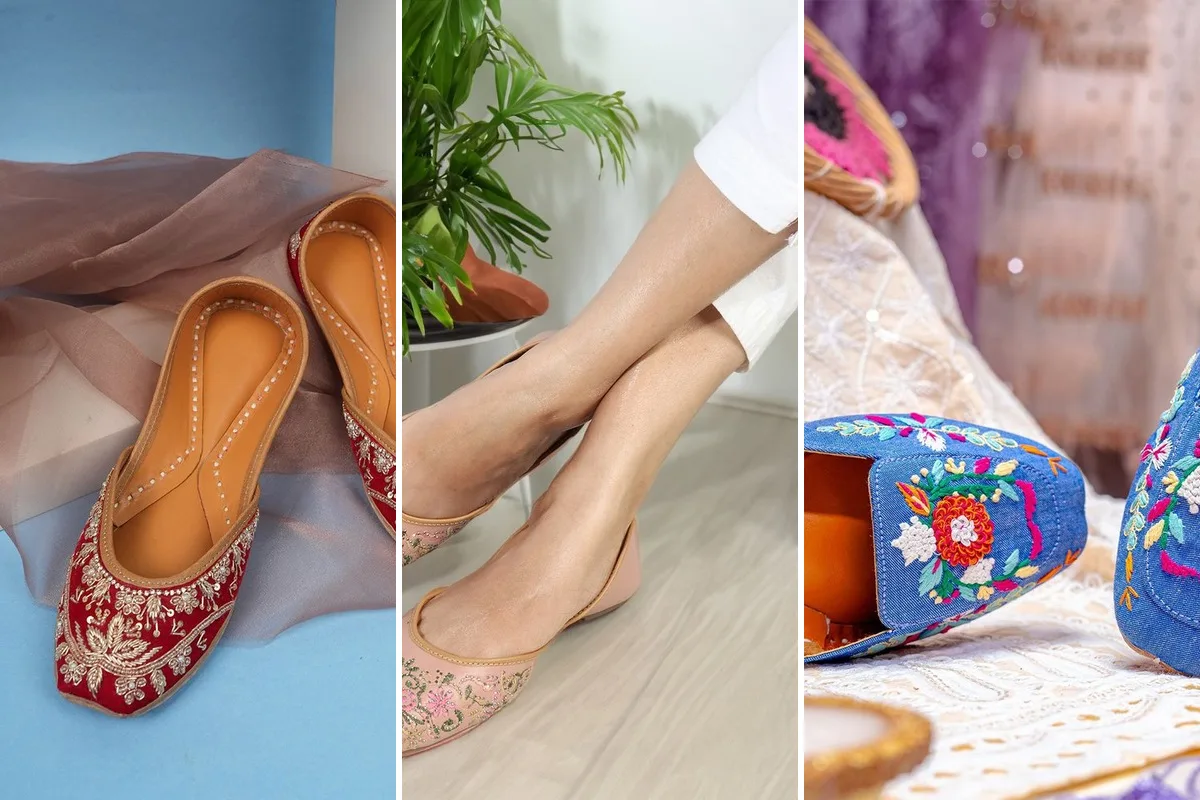
Juttis are flat, closed slip-on shoes from the Punjab region, traditionally made of leather and embroidered on the upper, often in metallic thread. Classic pairs have a thin sole, a back that rises to the heel tendon and no separate left or right shoe, so each one slowly takes the shape of your foot.
That is the short answer. The useful part is what comes next: how they differ from mojaris, how to wear them with jeans as easily as a lehenga, and how to get through the stiff first week. Browse the women's juttis and flats as you read, or jump to the size table if a wedding is close.
What are juttis made of?
Traditionally, leather, cotton thread and a lot of handwork. A jutti has three main parts: the upper (panna), the back (adda) and the sole (talla). Shoemakers stitch them together with thick cotton thread, and embroiderers work the upper before it is attached.
Punjab's craft has its own words for leather too. Dhodi juttis use hard hide, nari juttis use soft goat leather, and dukhli juttis use a double layer, inside and out. Today you will also meet synthetic leather, velvet, canvas, denim and rubber soles. These newer materials let designers treat the upper like a small canvas for phulkari (floral darning stitch from Punjab), zardozi (metal thread work), mirrors and beads.
Where do juttis come from?
Juttis belong to Punjab, now divided between India and Pakistan, with roots in royal Mughal footwear. Gurdeep Kour's 2020 paper in The Chitrolekha Journal on Art and Design says the closed shoe called jutti, an Urdu word, came in with the Mughals and was popular with royalty, whose pairs carried gold and silver thread and even precious stones.
Treat the finer details with some care. One old style, the Salim Shahi, is named after a Salim, but the sources disagree on which one: the paper points to a ruler of the early 16th century, while the craft archive Gaatha credits the Mughal prince who became Emperor Jahangir. What nobody disputes is that each town built its own look.
| Place | Known for |
|---|---|
| Muktsar | Tilla (metallic thread), zari and phulkari work |
| Patiala | Heavy embroidery and bright colours; a big jutti market |
| Fazilka | Gold and silver tilla embroidery done by hand |
| Kasur, now in Pakistan | Traditional embroidery and an indented toe |
| Chakwal, now in Pakistan | A raised heel and a long tip |
Juttis vs mojaris: what is the difference?
Mostly geography and the toe. Jutti is tied to Punjab and mojari to Rajasthan, and a mojari is more likely to have the curled-up tip. In real life the words overlap: many Indians outside Punjab simply say mojari, and plenty of labels put both words on one shoe. So look at the shape rather than the name.
| Name | Linked to | What to look for |
|---|---|---|
| Jutti | Punjab | Flat, closed slip-on, embroidered upper, round or M-shaped front |
| Mojari | Rajasthan | Very similar, often with a curled or upturned toe |
| Khussa | Pakistan and Punjab | A longer, broader tip; also the everyday name for a jutti in Pakistan |
| Kolhapuri | Maharashtra | A different shoe altogether: an open leather sandal |

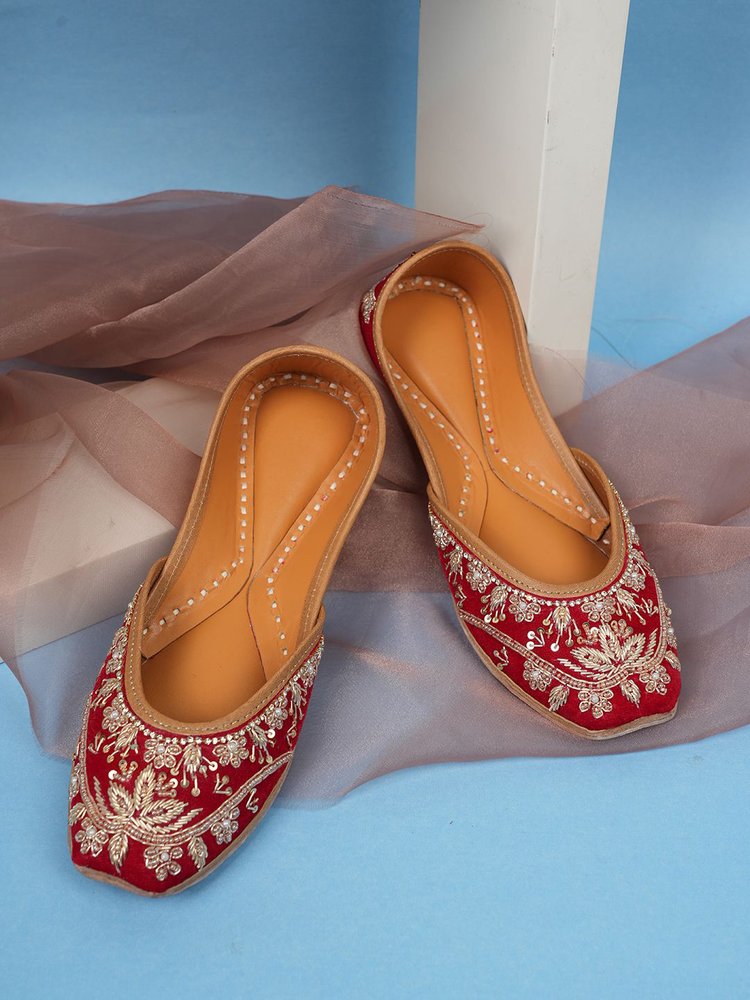
The classic, in hand-embroidered leather
Maroon and gold, with embroidery across the whole front, this is what most people picture when they hear the word. It suits a wedding function, and the leather upper is the kind that softens with wear.
- Leather upper with hand embroidery
- Cushioned footbed for long functions
- Rich enough to carry a plain outfit
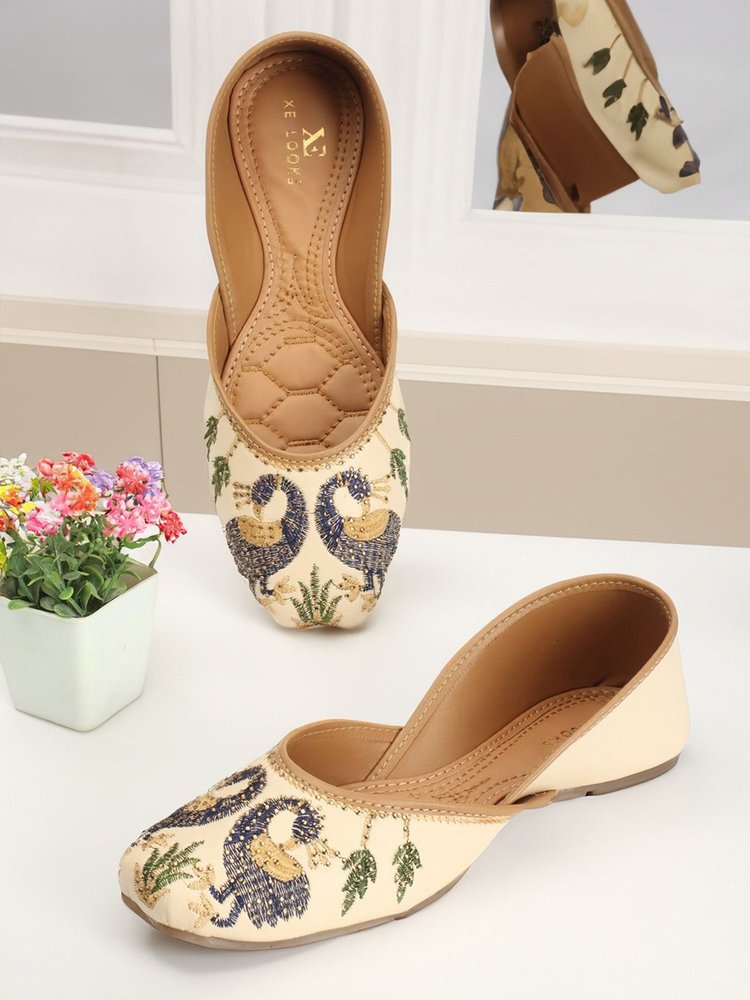
Embroidered juttis for weddings and festive nights
Zardozi-style florals, pearl work, sequins and mirrors, for when the shoes are part of the outfit.


How are men's and women's juttis different?
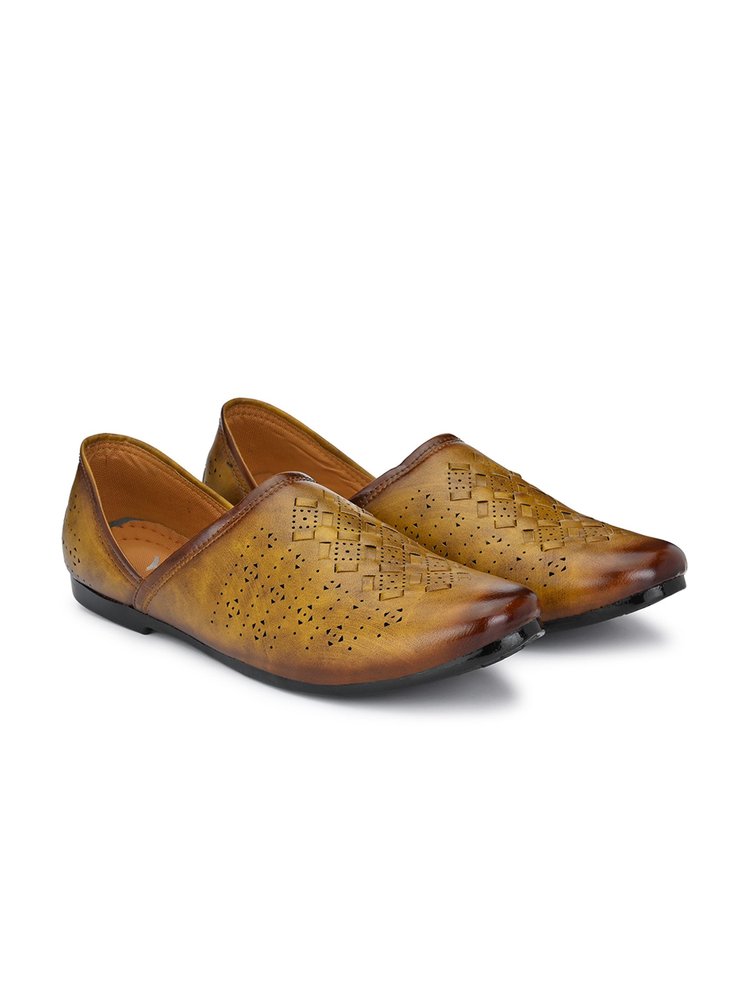
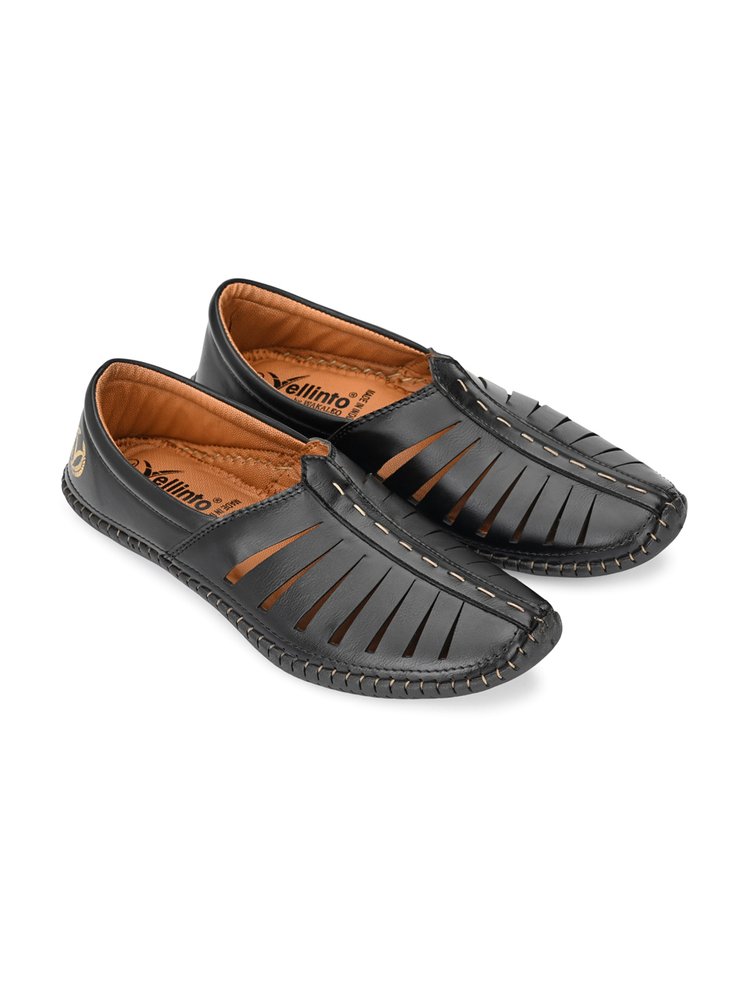
The classic men's jutti has a sharp, extended tip that curves up like a moustache, while some women's pairs drop the back entirely. Otherwise the two share the same build. Modern men's pairs tend to have a rounder toe and quieter textures, so they sit well under a kurta or with a plain shirt.
Men should match the shoe to the weight of the outfit: a plain or woven pair with a kurta, and velvet or embroidery with a sherwani. If you are still deciding on the outfit itself, read kurta vs sherwani and what men wear to an Indian wedding, then see the men's mojaris and casual shoes. For a look at how one long-running Indian footwear label thinks about shoes, read its brand story.
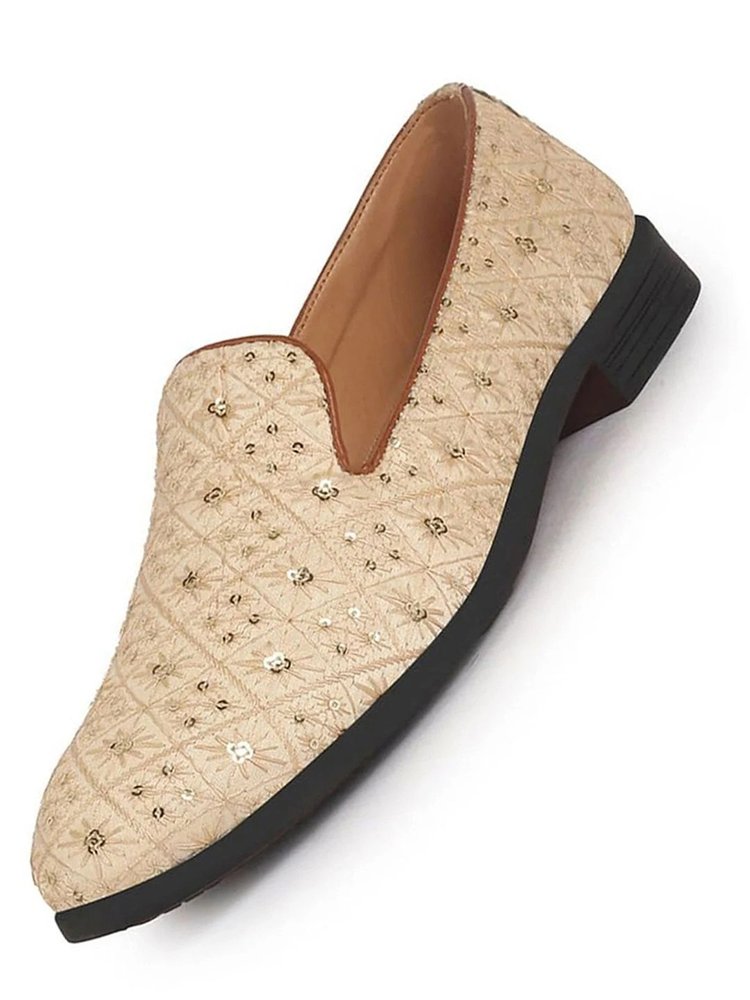
For a groom's side or a big reception
A velvet upper with sequin embroidery gives enough shine for a sherwani without looking like costume. The insole is memory foam, which helps on a night that runs late.
- Velvet upper with sequin work
- Memory foam insole
- Wipe clean with a dry cloth
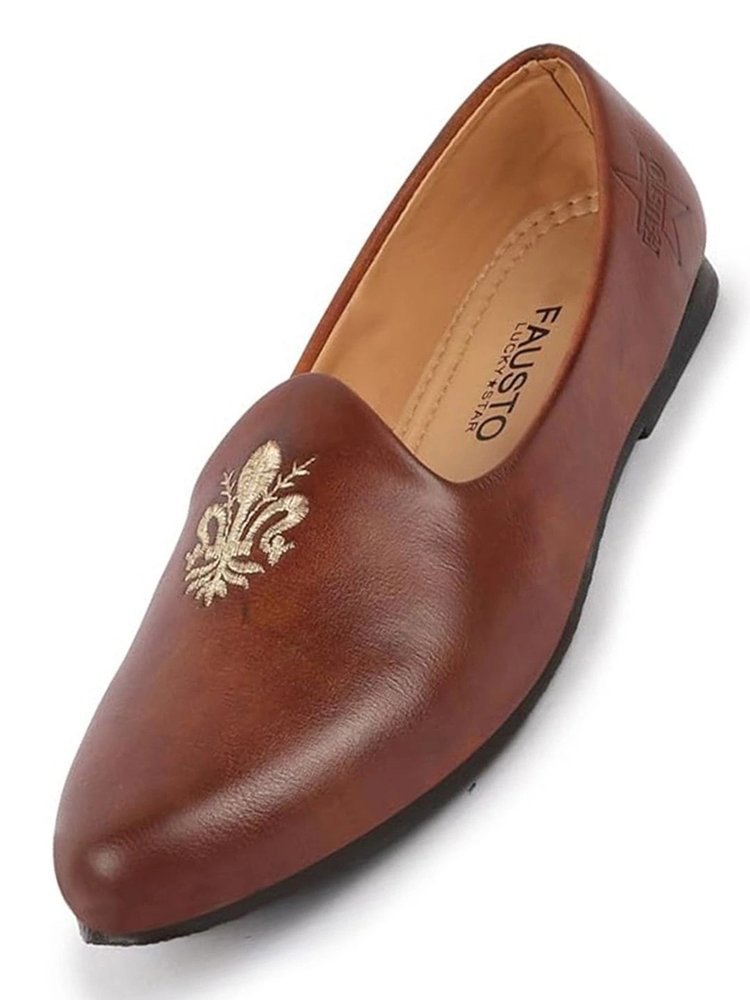
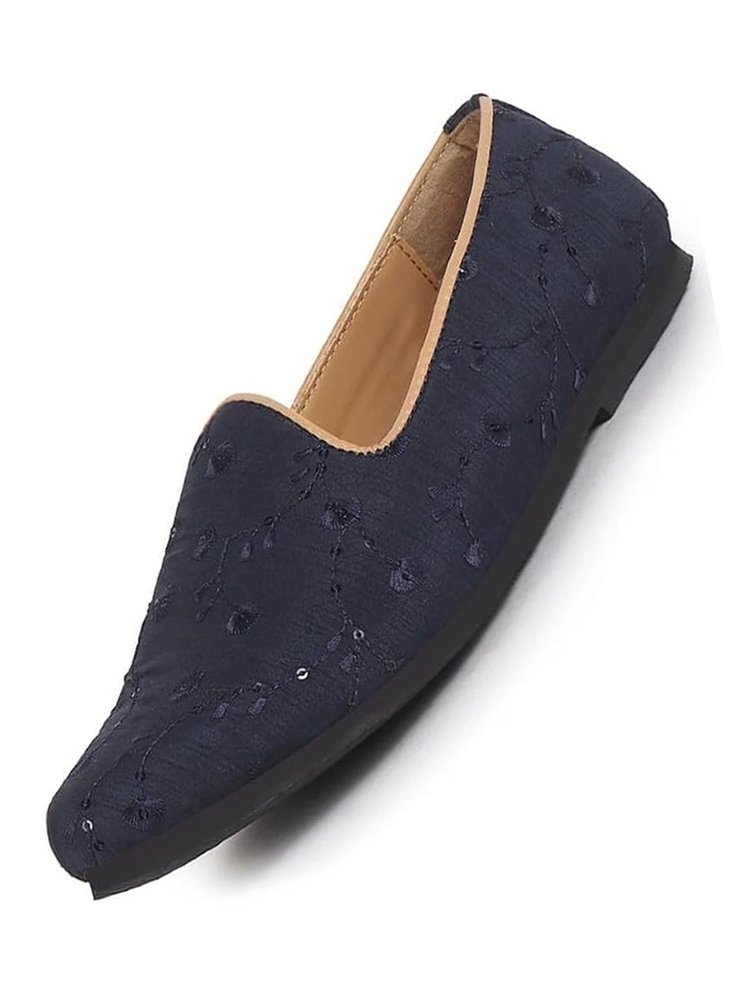
Men's pairs, from kurta days to wedding nights
Woven, perforated and embroidered, in tans, browns, black and cream.
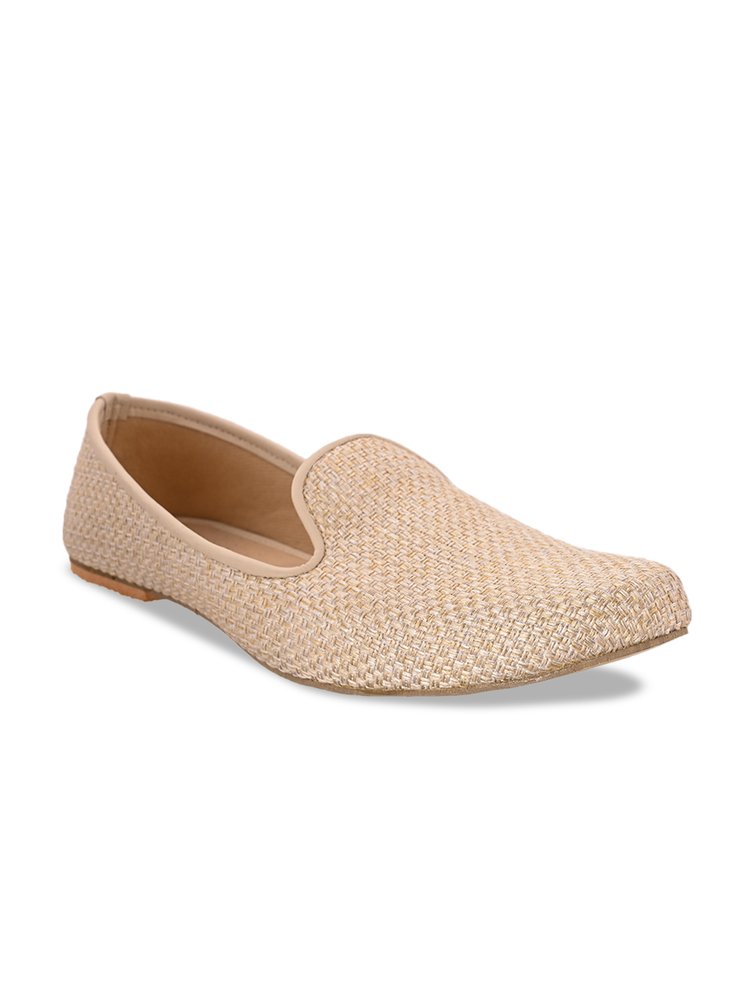
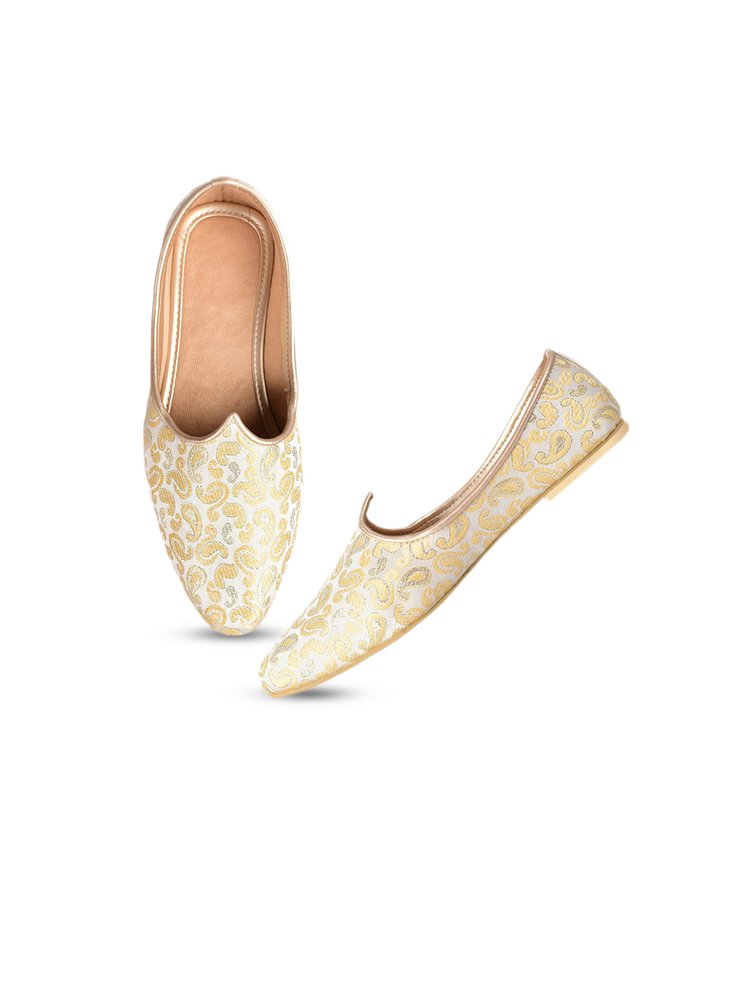
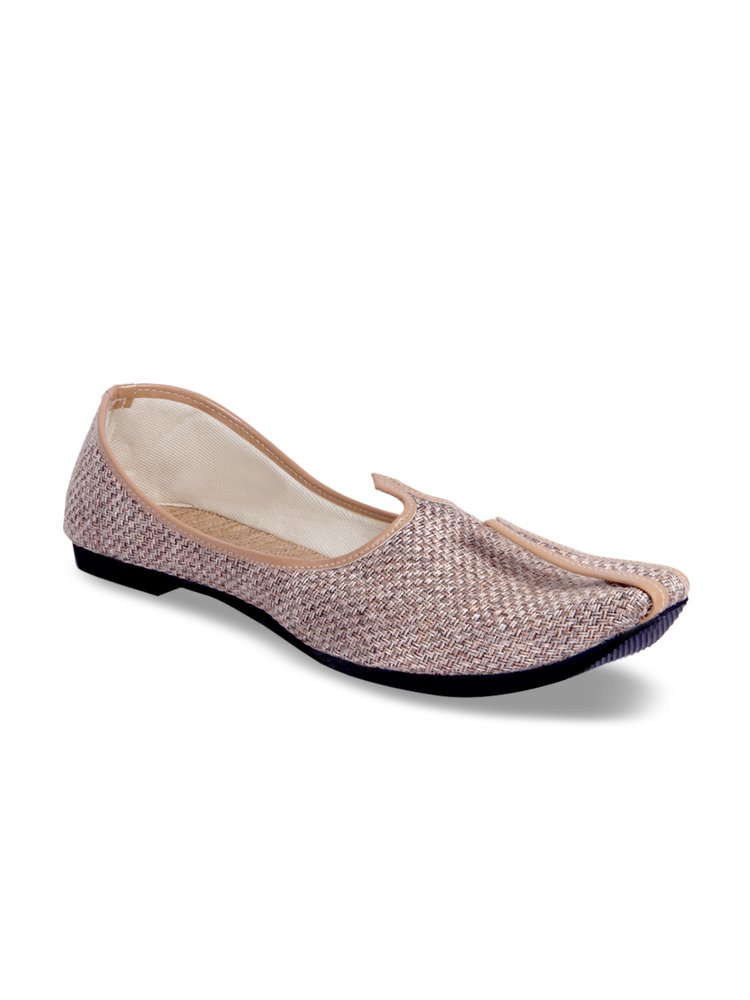
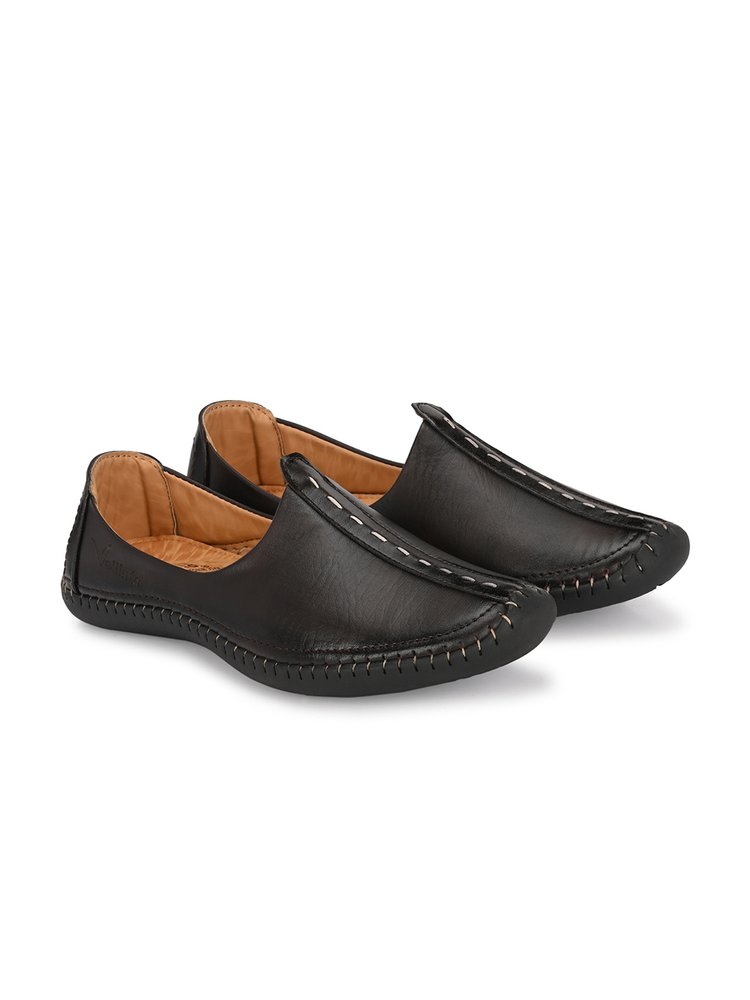
How do you wear juttis, including with jeans and dresses?
Let the juttis be the loud part and keep everything near them quiet. They are low and flat, so anything that hides the front wastes them. That means hems at the ankle or higher for jeans and dresses, and a lehenga or saree cut to clear the floor.
| Outfit | Which juttis | How to make it work |
|---|---|---|
| Straight or cropped jeans | Bright floral or denim-upper pairs | Show some ankle; roll the hem if it covers the embroidery |
| Midi or shirt dress | One colour lifted from the print, or gold on a plain dress | Skip big jewellery so the shoes get the attention |
| Wide-leg trousers | Square or pointed toe in a solid or tonal finish | Hem so the toe peeks out |
| Kurta set | Printed or lightly embroidered | Echo the dupatta's colour, not the kurta's |
| Anarkali or lehenga | Metallic or zardozi-style | Have the hem finished wearing the shoes you will actually wear |
| Men's kurta and churidar | Plain, woven or lightly embroidered | Keep the shoe in the same colour family as the jacket or stole |
More outfit ideas are in our guides to styling an anarkali, the kurta set and Indo-western looks. For a wedding, start with what to wear as a guest or the wedding guest edit.

The pair to try with jeans first
A denim upper with embroidered flowers is the easiest way into juttis if you have never worn them. It looks at home with blue jeans or a white shirt dress, and it never reads as wedding wear.
- Fabric upper on a leather sole
- Cushioned footbed
- The label asks for dry cleaning only
Everyday juttis for jeans, dresses and work
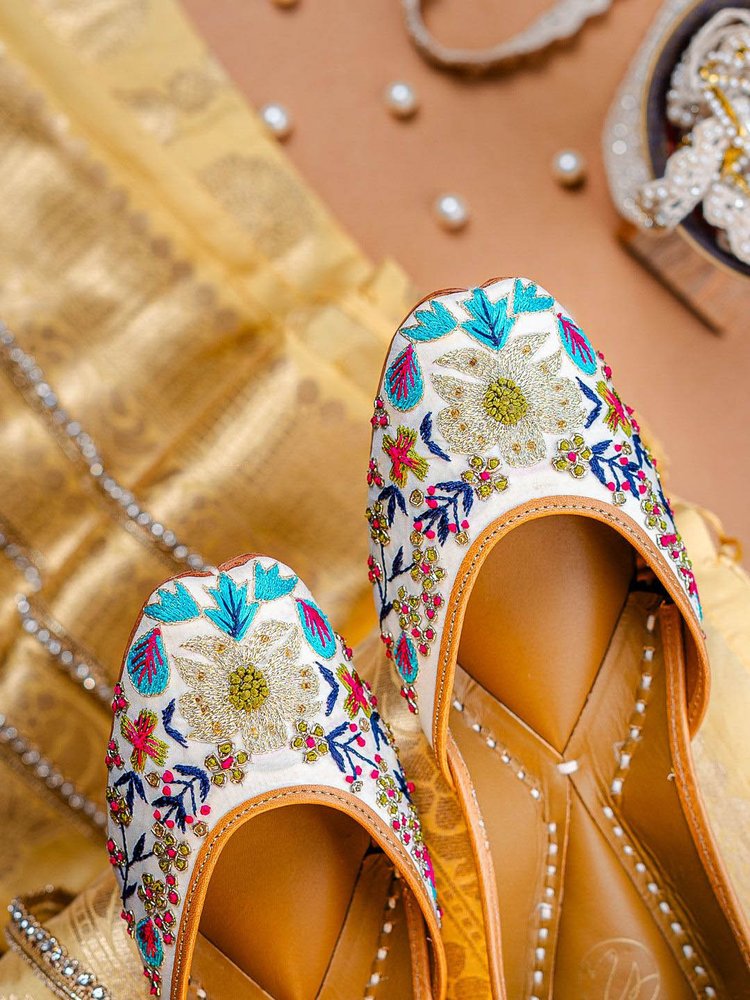
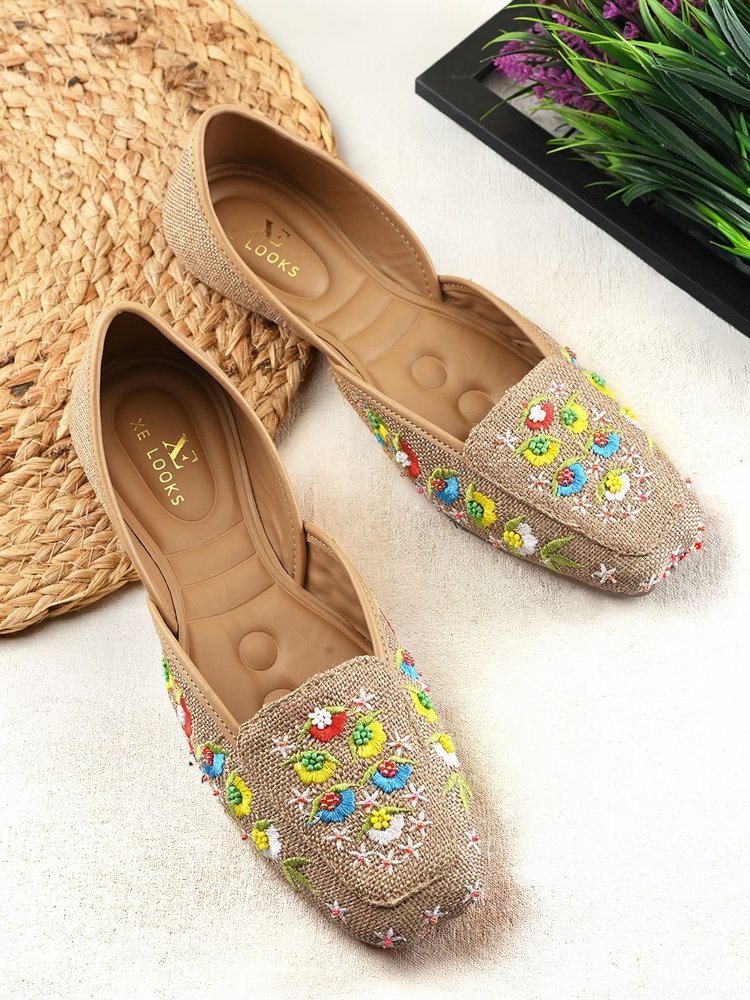
Softer colours, simpler work, and a backless pair for warm days.



Are juttis comfortable?
Yes, once they have softened, and some pairs from the first wear. It depends mostly on what they are made of. A traditional leather pair can pinch at the toes and rub at the heel until it gives. Synthetic and fabric pairs usually feel easier straight away, and many have a cushioned footbed.
| Upper | First wear | Over time | Choose it for |
|---|---|---|---|
| Leather | Often snug and stiff | Softens and shapes to your foot | Pairs you will keep and wear often |
| Synthetic leather | Usually easy | Changes little, so the first fit is close to the final fit | Travel and a pair you need soon |
| Fabric, denim or velvet | Soft | Upper relaxes, but marks more easily | Dry days and statement looks |
Be honest about when they are the wrong shoe. With no strap or fastening and a thin sole, juttis are poor for long walks on wet pavement or a day of sightseeing. Keep them for the event and travel in something else.
How do you break in juttis?
Wear them at home in short stretches with socks, well before the event, and let your feet do the work. Never soak them or force them.
- If your pair has no left or right, choose one for each foot and keep it there, since each shoe will mould to the foot that wears it.
- Wear them on a clean floor with thin cotton socks for short spells, and take them off when they start to hurt.
- If they stay tight, move up to thicker socks for an evening or two.
- Stuff the tight spot with clean socks or soft paper overnight so it holds the extra room.
- On plain leather only, work a little leather conditioner into the stiff area. Test it somewhere hidden first and keep it well away from embroidery.
- For the big day, put blister plasters on the heel and little toe before you leave the house, not after they start to rub.
What size jutti should you buy?
Buy to your foot length, not your usual US number, because Indian shoe sizes follow the UK scale. Stand on paper, mark your heel and longest toe, and measure the gap. Then use the table, and check the size chart on the product page, since labels differ.
| Foot length | India / UK | US women | US men | EU |
|---|---|---|---|---|
| 22.0 cm (8 2/3 in) | 3 | 5 | 4 | 35 |
| 22.9 cm (9 in) | 4 | 6 | 5 | 36.5 |
| 23.7 cm (9 1/3 in) | 5 | 7 | 6 | 37.5 |
| 24.6 cm (9 2/3 in) | 6 | 8 | 7 | 39 |
| 25.4 cm (10 in) | 7 | 9 | 8 | 40 |
| 26.2 cm (10 1/3 in) | 8 | 10 | 9 | 41.5 |
| 27.1 cm (10 2/3 in) | 9 | 11 | 10 | 42.5 |
| 27.9 cm (11 in) | 10 | 12 | 11 | 44 |
| 28.8 cm (11 1/3 in) | 11 | 13 | 12 | 45.5 |
- Leather: snug is fine, painful is not. Leather softens and moulds more than it truly stretches, so a pair that hurts across the widest part of your foot may stay that way.
- Synthetic: buy the size that fits now, because it will not give much.
- Between sizes: go up, which is also what one label on this store tells its own customers, and add a heel grip if the back slips.
- Wide feet: look for a round or square toe rather than a narrow, pointed one.
Ordering an outfit at the same time? Our Indian size chart for women covers clothing the same way.
How do you care for juttis?
Keep them dry, clean them gently and give them room when you store them. Most of the damage comes from rain, from being crushed in a bag and from being pulled off by the heel.
- After each wear: wipe with a soft, dry cloth, and brush embroidery lightly rather than rubbing it.
- Leather: use a leather conditioner now and then, on the leather only.
- Fabric, velvet and heavy embroidery: follow the care line on the pair. Several makers here ask for dry cleaning only.
- If they get wet: stuff with paper and let them dry at room temperature, away from a heater.
- Storage: keep them in the dust bag or a muslin cloth, in a dry place, not in plastic.
- Putting them on: ease your heel in with a finger or a shoehorn, because a crushed back rarely recovers.
Questions people ask
Do juttis have a left and a right?
Classic handmade juttis do not: both shoes are cut the same and each slowly takes the shape of the foot wearing it. Many modern pairs are made as a left and right, so check the photos. If yours are identical, keep each on the same foot.
Are juttis and mojaris the same thing?
Nearly. Jutti is linked to Punjab and mojari to Rajasthan, and a mojari is more likely to have a curled toe. Many people and labels use the two words for the same shoe, so go by the shape you want.
Can you wear juttis with jeans?
Yes, and it is one of the easiest ways to wear them. Choose cropped or straight jeans, or roll the hem so the embroidery shows, and keep the top simple. Denim-upper and floral pairs look the least formal.
Do juttis stretch?
Leather juttis soften and mould to your foot, and they give a little across the widest part. Synthetic pairs change very little. If a pair is painful rather than just snug when you try it, choose a larger size instead of hoping.
Can men wear juttis?
Yes, juttis have long been worn by men in Punjab, and they are a standard choice with a kurta or sherwani. Modern men's pairs often have a rounder toe, and they also work with chinos and a plain shirt.
Can you wear juttis in the rain?
Better not. Water can mark leather and embroidery, and thin soles give little protection. Wear something else for the journey and change at the venue. If they do get wet, stuff them with paper and dry them away from direct heat.
About the numbers
- Gurdeep Kour, Versatility in Designs of Punjabi Jutti, The Chitrolekha Journal on Art and Design, Vol. 4, No. 1, 2020, read 2026-11-03: Mughal link, Salim Shahi in the early 16th century, centres of the craft, types of leather and newer materials
- Gaatha craft archive, The Sole of Punjab, read 2026-11-03: Names of the parts, Fazilka tilla work, Patiala as a market, the Salim Shahi credited to the prince who became Jahangir, no left or right
- Wikipedia, Jutti, read 2026-11-03: Shape and back height, moulding to the foot, men's curved tip, backless women's pairs, mojari and khussa as other names
- Wikipedia, Shoe size, and Blitzresults shoe size chart, read 2026-11-03: India follows the UK scale; foot lengths and EU sizes from the chart; US men's about UK plus 1 and US women's about UK plus 2 from Wikipedia
- Google autocomplete, US, read 2026-11-02: The questions readers type: how to break in juttis, are juttis comfortable, what are juttis made of, how to wear juttis